


Short answer: you get around the Maldives by boat and small plane, not by road. From Velana International Airport (MLE) near Malé, resorts within about 60 to 75 minutes are reached by speedboat (roughly 100 to 490 US dollars return per adult), further atolls by seaplane (roughly 400 to 820 US dollars return, daylight only) or by domestic flight plus a short boat, and local islands by public ferry for as little as 1 to 3 US dollars. Your resort or guesthouse usually arranges the transfer when you book.
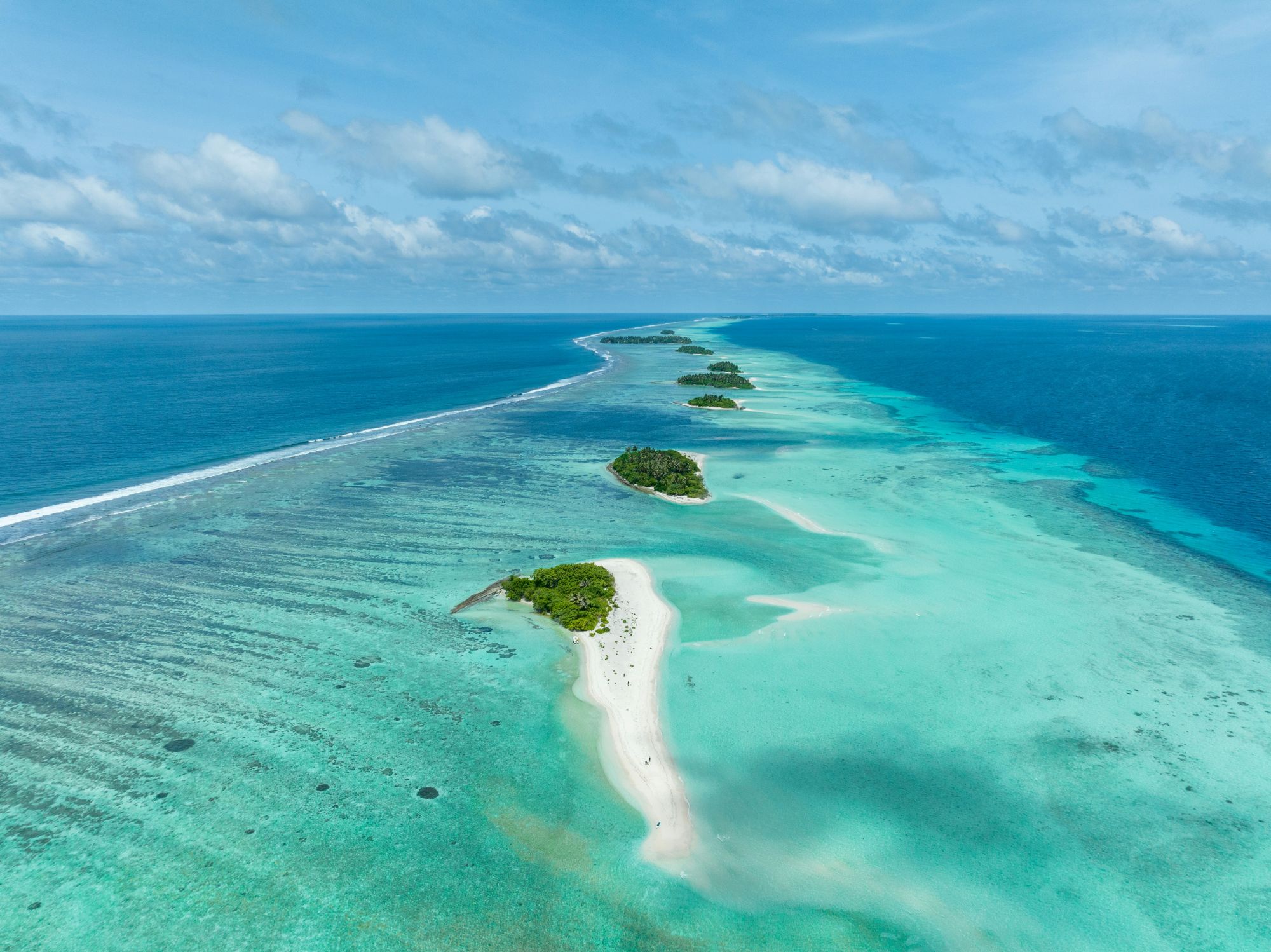
The Maldives is a chain of about 1,190 coral islands grouped into 26 natural atolls, stretching roughly 870 kilometres from north to south. Only around 200 islands are inhabited by Maldivians, and more than 170 are resort islands, each of them a separate island with its own jetty. There is no road network linking the atolls, so the transfer shapes both your budget and your arrival day. This guide explains every option, what it costs as of 2026, how long it takes and how to choose, so you can plan the journey before you commit to a resort or island.
If you are still at the early planning stage, start with our complete Maldives travel guide, then come back here to plan the transfers.
What are the main ways to get around the Maldives?
There are five main ways to move around the Maldives: speedboat, seaplane, domestic flight, public ferry and, around the capital, road transport by taxi and bus. Almost every journey begins at Velana International Airport on Hulhulé island, and the right choice depends on how far your island sits from the airport and what time your international flight lands.
| Mode | Main operators | Best for | Runs after dark | Typical journey | Rough cost (as of 2026) |
|---|---|---|---|---|---|
| Resort speedboat | Operated by each resort | Resorts in North and South Malé atolls | Usually yes | 10 to 75 min | 100 to 490 USD return per adult |
| Seaplane | Trans Maldivian Airways, Manta Air, Maldivian | Resorts 80 to 250 km from Malé | No, daylight only | 20 to 45 min flight | 400 to 820 USD return per adult |
| Domestic flight plus boat | Maldivian, Manta Air, Villa Air (FlyMe) | Far north and far south atolls | Some evening flights | 25 to 80 min flight plus boat | 350 to 520 USD return per adult |
| Public ferry (MTCC / RTL) | Maldives Transport and Contracting Company | Local islands, budget travel | Rarely | 45 min to several hours | About 1 to 30 USD one way |
| Shared local speedboat | Private island operators | Local islands near Malé | Limited | 30 to 90 min | About 20 to 60 USD one way |
| Taxi and bus | Licensed taxis, MTCC buses | Airport, Malé, Hulhumalé | Taxis 24 hours | 5 to 20 min | About MVR 10 to 85 |
Prices are indicative ranges from published resort and operator rates; always ask for a written, dated price per traveller.
How do you get from Velana Airport to Malé and Hulhumalé?
You can reach Malé from the airport in about 10 to 20 minutes by public ferry, bus or taxi. The 2.1 kilometre Sinamalé Bridge, opened in 2018, links Malé to Hulhulé (the airport island), which is joined by road to the reclaimed island of Hulhumalé. All three are covered by government regulated taxi fares.
| Option | Route | Fare (approx., check locally) | Frequency / hours | Time |
|---|---|---|---|---|
| Airport ferry | Airport jetty to Malé waterfront | About MVR 15 to 20 | Every 10 to 15 min by day, less often overnight | About 10 min |
| MTCC bus | Airport to Malé | About MVR 10 | Roughly hourly, early morning to after midnight | 15 to 25 min |
| MTCC bus | Airport to Hulhumalé | About MVR 10 to 15 | Roughly every 30 min | 10 to 15 min |
| Taxi (up to 6 seats) | Airport to Malé | MVR 70 | 24 hours | 15 to 20 min |
| Taxi (up to 6 seats) | Airport to Hulhumalé Phase 1 / Phase 2 | MVR 80 / MVR 85 | 24 hours | 5 to 10 min |
| Taxi (up to 6 seats) | Within Malé or Hulhumalé | MVR 30 | 24 hours | 5 to 10 min |
The taxi fares are the regulated rates set by the transport authority in May 2024. Larger 7 to 10 seat vehicles cost more (for example MVR 110 from the airport to Malé), a small surcharge applies for pickups at the domestic terminal, and there is an extra MVR 5 for each bag beyond three. Carry some cash. The Maldivian rufiyaa (MVR) is managed against the US dollar at roughly MVR 15.4 to 1 USD as of 2026, and US dollars are widely accepted in tourist areas, though change is often given in rufiyaa.
What changed at Velana International Airport recently?
Velana has been rebuilt in stages. A new 3,400 metre runway and a new seaplane terminal both came into use in October 2022, and a new 78,000 square metre passenger terminal opened in phases from July 2025, with airlines moving across through late 2025.
The seaplane terminal has space for more than 100 seaplanes and around 300 flights a day, and the new terminal is built for over 7 million passengers a year. Confirm which terminal your airline uses a day before you fly.
How do speedboat transfers work?
Speedboat transfers are the standard way to reach resorts in North Malé and South Malé atolls. A resort representative meets you in the arrivals hall, walks you to the resort's boat at the airport jetty, and you are usually on the water within 20 to 40 minutes of clearing customs. Most speedboat resorts can meet flights at any hour.
- Distance: the closest resorts are about 10 to 15 minutes away; the furthest speedboat resorts can take 60 to 75 minutes.
- Cost: roughly 100 to 150 USD return per adult for the nearest resorts, 180 to 370 USD for mid-distance, and 350 to 490 USD for the furthest.
- Shared or private: the quoted rate is normally for a scheduled shared boat; a private boat costs more.
- Comfort: the sea can be choppy in the southwest monsoon (roughly May to October), so take seasickness tablets if you need them.
Can you arrive at night by speedboat?
Usually yes, which is the main advantage of a speedboat resort. A boat is not automatically available at every hour, though, and some resorts charge extra for very late runs.
How do seaplane transfers work, and when do they fly?
A seaplane is a small float plane, usually a de Havilland Canada Twin Otter carrying around 15 passengers, that lands on the lagoon beside your resort's floating platform. Flights last about 20 to 45 minutes and give superb aerial views. They fly only in daylight, because they land on water.
Three airlines fly seaplanes from the Velana seaplane terminal: Trans Maldivian Airways (TMA), the largest, serving more than 80 resorts; Manta Air, which began seaplane flights in November 2019; and Maldivian, the national carrier.
- Arrival cut-off: Trans Maldivian Airways advises landing in the Maldives by about 3.30 pm local time for a same-day seaplane. Later arrivals normally overnight near the airport.
- Departure window: on the way home, seaplanes generally suit international flights leaving after about 9 am, because the first seaplanes leave the resort after sunrise.
- Waiting time: seaplanes are grouped by route, so you may wait 1 to 3 hours in a resort or operator lounge. The flight time is short; the waiting is not.
- Cost: about 400 to 560 USD return per adult for the nearest seaplane resorts, rising to about 600 to 820 USD for the furthest.
- Weather: heavy rain or strong winds occasionally delay flights, which is another reason to leave a buffer before your international departure.
More detail on the official rules is in the Trans Maldivian Airways FAQ.
Seaplane or speedboat: which should you choose?
Choose a speedboat resort if you land late, want the shortest door to villa time or are watching costs; choose a seaplane resort if you want a more remote atoll, clearer and quieter reefs, and the flight itself as a highlight. Many couples on a Maldives honeymoon pick one seaplane stay for exactly that reason.
| Factor | Speedboat | Seaplane | Domestic flight plus boat |
|---|---|---|---|
| Typical range from Malé | Up to about 75 min by sea | 80 to 250 km | Far north or deep south |
| Night arrival | Usually possible | Not possible | Sometimes, on evening flights |
| Checked plus hand baggage | Generous, rarely weighed | 20 kg plus 5 kg (TMA) | Varies by airline and fare |
| Return cost per adult | About 100 to 490 USD | About 400 to 820 USD | About 350 to 520 USD |
| Children | Usually 30 to 50 percent less | Usually 30 to 40 percent less; under 2 often free | Discounted child fares |
| Scenery | Sea level | Spectacular aerial views | Aerial views plus a boat ride |
| Main drawback | Can be bumpy in rough seas | Price, waiting time, daylight only | Two connections, more handling |
The transfer is a large share of a Maldives budget for couples and families. Our guide to whether the Maldives is expensive shows how it fits alongside rooms, meals and taxes.
How do domestic flights work in the Maldives?
Domestic flights link Velana to about 18 regional airports across the atolls, flown by Maldivian, Manta Air and Villa Air (FlyMe). They are used for resorts and islands too far for a comfortable seaplane, and unlike seaplanes, some can operate after dark because they land on runways. Most resorts time a speedboat to meet your flight at the domestic airport.
Domestic flights leave from the domestic terminal at Velana, a short shuttle from international arrivals.
| Domestic airport | Atoll | Code | Approx. flight from Malé | Typical use |
|---|---|---|---|---|
| Villa International Airport, Maamigili | Alifu Dhaalu (South Ari) | VAM | About 25 to 35 min | South Ari resorts, whale shark area |
| Dharavandhoo | Baa | DRV | About 30 to 35 min | Baa Atoll UNESCO Biosphere Reserve resorts |
| Ifuru | Raa | IFU | About 35 to 45 min | Raa and Noonu resorts |
| Madivaru | Lhaviyani | LMV | About 30 to 40 min | Lhaviyani resorts |
| Dhaalu Airport, Kudahuvadhoo | Dhaalu | DDD | About 40 to 45 min | Dhaalu resorts |
| Kadhdhoo | Laamu | KDO | About 45 to 55 min | Laamu resorts and surf spots |
| Kooddoo | Gaafu Alifu | GKK | About 55 min | Huvadhoo Atoll resorts |
| Kaadedhdhoo | Gaafu Dhaalu | KDM | About 60 to 70 min | Southern Huvadhoo resorts |
| Gan International | Addu (Seenu) | GAN | About 70 to 80 min | Addu City, the southernmost atoll |
| Hanimaadhoo International | Haa Dhaalu | HAQ | About 60 to 70 min | Far north resorts and islands |
Flight times are approximate and vary with aircraft and routing, so treat them as a guide. Hanimaadhoo in the far north was rebuilt with a 2.46 kilometre runway and a new terminal designed for about 1.3 million passengers a year, inaugurated in November 2025, which should make northern atolls easier to reach over time.
Can you use public ferries in the Maldives?
Yes. Public ferries run by the state owned Maldives Transport and Contracting Company (MTCC), now under the Raajje Transport Link (RTL) brand, connect Malé with many inhabited islands. They are by far the cheapest way to travel, often 1 to 3 US dollars for islands near Malé, but they are slow, run on limited timetables and most do not sail on Fridays.
The RTL programme has added fast, air-conditioned ferries in several zones, including the Gaafu atolls, Fuvahmulah, Addu and the far north. RTL tickets can be bought through the RTL app or website for many routes; on older routes you may still pay cash at the terminal. Timetables change, so always check the latest schedule shortly before you travel.
| Sample route from Malé | Ferry fare (approx.) | Ferry time | Days | Shared speedboat alternative |
|---|---|---|---|---|
| Maafushi (South Malé Atoll) | About MVR 22 to 30 (under 2 USD) | About 1 hr 30 min | Saturday to Thursday | About 20 to 25 USD, 30 to 45 min |
| Gulhi (South Malé Atoll) | About MVR 30 | About 1 hr | Most days except Friday | Available via island operators |
| Huraa (North Malé Atoll) | About MVR 35 | About 1 hr | Several days a week | Available via island operators |
| Dhiffushi (North Malé Atoll) | About MVR 45 | About 1 hr 30 min to 2 hr | Several days a week | About 25 to 35 USD, 40 to 50 min |
| Ari Atoll islands (e.g. Ukulhas, Dhigurah) | Varies, often longer journeys | 3 hours or more, sometimes a change | Limited days | About 40 to 70 USD, 1 to 2 hr |
| Distant atolls | Up to about MVR 450 | Many hours | Limited days | Domestic flight usually better |
All fares are approximate and can change, so confirm with your guesthouse before you go.
Is the Friday ferry gap a real problem?
Yes, if you arrive or leave on a Friday. Friday is the weekly holiday in the Maldives and most public ferries do not run, while buses in Malé pause around midday prayers. On a Friday, plan on a shared speedboat instead, and ask your guesthouse to reserve seats in advance.
What can you take on a public ferry?
MTCC guidance allows around two pieces of luggage plus a handbag per passenger, with extra bags charged. Alcohol is not permitted on local islands or ferries; our Maldives dos and don'ts cover dress and conduct on local islands.
How much luggage can you take on Maldives transfers?
Baggage limits matter most on seaplanes. Trans Maldivian Airways allows 25 kg per person in total, made up of 20 kg of checked luggage and 5 kg of hand luggage, with excess charged per kilo. Speedboats are relaxed, and domestic flight allowances depend on the airline and your fare.
| Transport | Standard allowance | Excess or notes |
|---|---|---|
| Seaplane (TMA) | 20 kg checked plus 5 kg hand per person | About 5 USD per extra kg plus tax; no single bag over 32 kg; no extra infant allowance |
| Domestic flight (Maldivian, Manta, Villa Air) | Depends on fare and resort booking; often similar to seaplane levels | Maldivian publishes excess rates of roughly MVR 30 to 80 per kg on domestic routes |
| Resort speedboat | Normal holiday luggage | Declare large sports gear such as surfboards or dive kit |
| Public ferry | About 2 bags plus a handbag | Extra bags charged; bags may be stacked in the open |
Pack soft bags where you can, keep medicines and documents in your hand luggage, and tell the resort in advance about dive gear or surfboards.
How much do Maldives transfers cost as of 2026?
Resort transfers usually cost between roughly 100 and 820 US dollars return per adult, depending on distance and mode, and are almost always charged on top of the room rate. Local island travel is far cheaper: a public ferry is often under 3 US dollars and a shared speedboat around 20 to 70 US dollars one way.
Several taxes and fees sit around the transfer price. Knowing them avoids surprises on the final bill.
| Tax or fee | Current rate (as of 2026) | Applies to |
|---|---|---|
| Tourism GST (TGST) | 17 percent (since 1 July 2025) | Resort services, typically including transfers booked through the resort |
| Service charge | 10 percent | Resort and hotel services, usually including transfers |
| Green tax, resorts and tourist vessels | 12 USD per person per night (since 1 January 2025) | Resorts, resort hotels and liveaboards; under 2s exempt |
| Green tax, guesthouses | 6 USD per person per night | Guesthouses and hotels on inhabited islands with 50 rooms or fewer |
| Departure tax and airport development fee | About 50 USD economy, 120 USD business, 240 USD first (since 1 December 2024) | International departures; included in your air ticket |
Some resorts quote transfers with service charge and TGST included, others add 27 percent on top. Green tax rates are published by the Maldives Inland Revenue Authority; check before you travel.
How can you save on transfers?
- Pick a speedboat resort in North or South Malé Atoll if the transfer would otherwise decide your budget.
- Watch for resort offers that include free or discounted transfers for stays of a set number of nights.
- On a local island trip, use the public ferry on at least one leg, and a shared speedboat when timing matters.
- Ask for child pricing; children aged 2 to 11 are usually charged 30 to 50 percent less and infants are often free.
Families will find more on child pricing and resort choice in our guide to the Maldives with family.
What happens if your flight lands after dark?
If your flight lands after the last seaplane, usually mid to late afternoon, you will spend the night near the airport and fly out the next morning. Speedboat resorts and guesthouses on nearby local islands can usually still collect you in the evening, though late boats are not guaranteed everywhere.
| Your arrival time | Speedboat resort | Seaplane resort | Domestic flight resort | Local island guesthouse |
|---|---|---|---|---|
| Morning to early afternoon | Straight to resort | Same-day seaplane | Same-day connection | Ferry or speedboat |
| Around 3 pm to sunset | Straight to resort | Often too late; check with resort | Evening flight if available | Speedboat, as ferries may have left |
| Evening | Usually possible | Overnight in Hulhumalé or at the airport | Possibly an overnight, check schedule | Speedboat if operator agrees |
| Late night or early morning | Check; may need an overnight | Overnight, first seaplane next day | Overnight | Overnight in Hulhumalé |
Many travellers from South Asia and the Middle East land in the evening, so check transfer times before choosing a resort.
How do you get around on a resort or local island?
On a resort island you walk, cycle or ride a buggy; on a local island you walk or hire a bicycle. Islands are small, often only a few hundred metres across, so cars are rarely needed outside Malé, Hulhumalé and Addu.
- Resorts: larger resorts provide bicycles and electric buggies, and some have villas more than a kilometre from the main jetty. Call reception for a buggy, especially with luggage or young children.
- Local islands: most guesthouses, cafés, dive centres and the designated bikini beach are within a 5 to 15 minute walk. Guesthouses often lend or rent bicycles.
- Island hopping: from local islands, guesthouses and excursion operators run shared speedboat trips to sandbanks, snorkel reefs and nearby resort day visits.
For ideas on what to do once you arrive, see things to do in the Maldives, and for the islands that suit different budgets, our guide to the best islands in the Maldives.
Which transfer suits each atoll?
As a rule of thumb, North and South Malé atolls are speedboat country, Ari, Baa, Raa, Lhaviyani and Vaavu are mainly seaplane or long speedboat transfers, and the far south and far north use domestic flights. This planning table shows the usual pattern.
| Atoll or area | Usual resort transfer | Approx. total time from MLE | Local island access |
|---|---|---|---|
| North Malé (Kaafu) | Speedboat | 10 to 60 min | Ferry or speedboat to Huraa, Himmafushi, Thulusdhoo, Dhiffushi |
| South Malé (Kaafu) | Speedboat | 20 to 75 min | Ferry or speedboat to Maafushi, Gulhi, Guraidhoo |
| North and South Ari (Alifu) | Seaplane, or domestic flight to Maamigili plus boat | About 30 to 90 min | Speedboat to Ukulhas, Rasdhoo, Dhigurah, Dhangethi |
| Vaavu | Seaplane or long speedboat | About 1 to 1.5 hr | Speedboat to Fulidhoo, Thinadhoo |
| Baa | Seaplane, or domestic flight to Dharavandhoo plus boat | About 35 min to 1.5 hr | Speedboat or ferry to Dharavandhoo, Thulhaadhoo |
| Raa and Noonu | Seaplane, or domestic flight to Ifuru plus boat | About 45 min to 1.5 hr | Limited, mostly via domestic flight |
| Lhaviyani | Seaplane, or domestic flight to Madivaru plus boat | About 40 min to 1.5 hr | Limited |
| Dhaalu and Meemu | Seaplane or domestic flight plus boat | About 1 to 1.5 hr | Limited |
| Laamu | Domestic flight to Kadhdhoo plus boat | About 1.5 hr | Local islands via RTL ferry or speedboat |
| Gaafu Alifu and Gaafu Dhaalu | Domestic flight to Kooddoo or Kaadedhdhoo plus boat | About 1.5 to 2.5 hr | RTL fast ferries within the atolls |
| Addu (Seenu) | Domestic flight to Gan, then road or boat | About 1.5 to 2 hr | Causeway road between islands |
| Haa Alifu and Haa Dhaalu | Domestic flight to Hanimaadhoo, or seaplane | About 1.5 to 2 hr | RTL ferries within the northern atolls |
Times include typical connections and are only a guide; your resort confirms the exact arrangement at booking. For the season that suits each area, see the best time to visit the Maldives.
What should you know before booking Maldives transfers?
Send your international flight numbers and times to the resort or guesthouse as soon as you book, because transfers are built around them. Then check the arrival cut-off, the baggage limit and whether the quoted transfer price includes tax.
- Book the transfer with the stay. Resort transfers are arranged by the resort; seaplane seats are allocated in advance and fill up in peak months from December to April.
- Match flight times to the transfer type. For a seaplane resort, aim to land by early afternoon and to fly home after mid-morning.
- Ask for the full price. Request a dated, per-person return price and whether 10 percent service charge and 17 percent TGST are included.
- Check Fridays. If you are using public ferries, avoid arriving or departing on a Friday or budget for a speedboat.
- Complete the traveller declaration. All visitors complete the IMUGA online traveller declaration within 96 hours of arrival and departure. Most nationalities, including Nepali passport holders, receive a free 30-day tourist visa on arrival with a valid passport, confirmed accommodation, a return ticket and sufficient funds.
- Keep a buffer. Allow at least three to four hours between a seaplane or domestic landing and your international departure.
- Carry small cash. Keep some rufiyaa or small US dollar notes for taxis, ferries and tips.
Practical tip: if you want two contrasting stays, place the speedboat resort at the start of the trip, when you are likely to land late, and the seaplane resort in the middle, so every seaplane leg happens in daylight.
Once the transport is sorted, you can shape the rest of the trip with our Maldives itinerary ideas. If you would rather have flights, transfers and hotels arranged together, compare Maldives holiday packages.
Frequently asked questions
Do you need a seaplane to reach every Maldives resort?
No. Resorts in North and South Malé atolls are reached by speedboat in roughly 10 to 75 minutes, and speedboats can usually run at night. Seaplanes are needed only for resorts too far for a comfortable boat ride, typically 80 to 250 kilometres from Malé, and some far atolls are reached instead by a domestic flight followed by a short speedboat transfer.
How much does a seaplane transfer cost in the Maldives?
As of 2026, a Maldives seaplane transfer usually costs about 400 to 820 US dollars return per adult, depending on distance. The nearest seaplane resorts sit at the lower end, the furthest at the top. Children aged 2 to 11 usually pay 30 to 40 percent less, infants are often free, and resorts may add 10 percent service charge and 17 percent TGST.
Do seaplanes fly at night in the Maldives?
No. Maldives seaplanes land and take off on water, so they operate only in daylight, from around sunrise to mid or late afternoon. Trans Maldivian Airways advises landing by about 3.30 pm for a same-day transfer. If you arrive later, you normally stay overnight in Hulhumalé or at the airport and take the first seaplane the next morning.
Are public ferries good for tourists in the Maldives?
Yes, for budget travellers staying on local islands who are happy with slower, scheduled travel. Maldives public ferries run by MTCC under the RTL brand often cost under 3 US dollars from Malé to nearby islands. They suit flexible trips, but they do not reach resorts, run limited timetables and most do not sail on Fridays.
Do ferries run on Fridays in the Maldives?
Mostly not. Friday is the weekly holiday in the Maldives, and most public ferry routes do not operate that day, while Malé buses pause around midday prayers. If you must arrive at or leave a local island on a Friday, book a shared or private speedboat through your guesthouse in advance, and expect to pay more than the ferry fare.
How long is the transfer from Malé airport to a resort?
It ranges from about 10 to 15 minutes by speedboat for the closest Maldives resorts to 20 to 45 minutes by seaplane for more distant atolls, plus any waiting time. Resorts in the far south may need a domestic flight of up to about 80 minutes followed by a boat. Your resort confirms exact timings once it has your flight details.
How do you get from Malé airport to Malé city?
You can take the airport ferry across to Malé in about 10 minutes, an MTCC bus over the Sinamalé Bridge for around MVR 10, or a regulated taxi for MVR 70 in a standard car. Taxis run 24 hours, the ferry runs day and night at longer intervals, and buses run from early morning until after midnight.
What is the baggage limit on a Maldives seaplane?
Trans Maldivian Airways, the largest Maldives seaplane operator, allows 25 kg per person: 20 kg of checked luggage and 5 kg of hand luggage. Excess baggage costs about 5 US dollars per kilo plus tax, no single bag may exceed 32 kg, and infants get no extra allowance. Soft bags and advance notice of sports gear make loading easier.
Can you island hop in the Maldives?
Yes, especially from local islands. Guesthouses in the Maldives run shared speedboat trips to sandbanks, snorkel reefs and neighbouring islands, and public ferries link many inhabited islands cheaply. Hopping between resorts is limited, because each resort is a private island and each move usually means a new paid transfer, so most travellers pick one or two bases.
What if my flight lands in the Maldives late at night?
If you land in the Maldives late, a speedboat resort can often still collect you, but a seaplane resort cannot, so you would stay overnight near the airport. Hulhumalé, 5 to 10 minutes from the terminal by taxi, has dozens of hotels and a public beach, which makes it the usual overnight base. Guesthouses on nearby local islands may send a speedboat if arranged in advance.
Are transfer costs included in Maldives resort prices?
Usually not. Most Maldives resorts quote transfers separately from the room rate, and the price may or may not include 10 percent service charge and 17 percent TGST. Some resorts run offers with free or discounted transfers for longer stays. Always ask for a written, dated, per-person return price so you can compare resorts fairly.
Which domestic airlines fly within the Maldives?
Three airlines fly domestic routes in the Maldives: Maldivian, the national carrier, Manta Air and Villa Air (FlyMe), which is based at Maamigili. Together they serve about 18 regional airports, from Hanimaadhoo in the far north to Gan in Addu Atoll. Resorts in distant atolls usually book these seats for you and time a speedboat to meet the flight.

'/%3E%3C/svg%3E)